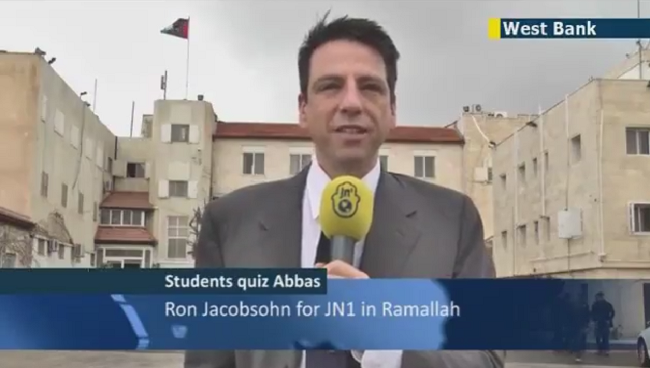
A few thousand Israeli students applied on the Facebook page of pro-peace organization, One Voice, for a once in a lifetime experience to meet the President of the Palestinian Authority, Mahmoud Abbas, for a Q&A session at the Muqata in Ramallah. Almost five months later, six buses filled with chosen students have made their way for the historic event.
In an attempt to defuse some of the more controversial questions, Abbas in an almost 45-minute speech ahead of the Q&A, addressed issues like his defiance to recognize Israel as a Jewish state something he sees no need for doing being he recognized Israel as a state, the fact that he won’t allow any Israeli setlers to stay in the future Palestinian State, that he believes that once an agreement with Israel will be reached the Hamas in Gaza will accept it as well, he sees the future of Jerusalem as a united city governed by both an Israeli and a Palestinian major, stating that claims he is an anti-Semite are totally false and finally critizing the Netanyahu government of not honoring the agreements reached with the previous Israel government making the PA start the negotiations from scratch.
Although the Israeli students did not receive the answers they expected to receive from the Palestinian President, the beginning of this process of talking directly to each other is a historic event by itself.
Israeli Russian speaking television network, Channel 9, has shocked its viewers when they asked them to participate in a poll where they were asked the question: do you think the Jews in Europe were at fault in what happened in the holocaust? The media backlash was not far to follow and it has yet to be determined if channel 9’s little media stunt will help or hurt it eventually in the ratings.
Ron Jacobsohn, JN1 Correspondent:
Israeli Russian speaking television network, Channel 9, has shocked its viewers when they asked them to participate in a poll where they were asked the question: do you think the Jews in Europe were at fault in what happened in the holocaust? The media backlash was not far to follow, so we wanted to find out what the idea behind such a controversial poll could be.
Leonid Kanfer, the editor-in-chief of Channel 9 News, is a fairly new addition to the channel moving from his previous job at REN TV (РЕН ТВ) in Moscow. Kanfer claims he could not work anymore for an industry, which has forgotten what free press feels like. The poll he instigated for Channel 9 was a reaction to the poll published recently by Russian TV channel, Dozhd (ʓождь), which got the station almost shut down by the government for dealing with a touchy subject about Russia and World War Two.
Leonid Kanfer, Head Editor Channel 9 News:
When we had asked the question we understood beforehand that we’re positioning ourselves on slippery ground, where there are things that are holy for many Israelis, Jews. With that, we also knew for a fact that here in Israel we won’t be closed down, nobody will kick us off air and if there will be sanctions of some kind, they will be decided in a court of law, one that the population has trust in. And we understood that in the worse case scenario, we will be faced with people’s reactions, those of them who felt offended. But posing the question, we ourselves did not give an answer to it. If we would have addressed the same question to ourselves, the journalists of Channel 9 would unanimously answer that no, of course not. The Jews, in no way, in no shape or form are not to blame for the holocaust, in direct or indirect form and that would be the answer of all our journalists. Consciously, we were asking it the wrong way, consciously posing it in a provocative fashion, in order to simply to demonstrate that Israel is a democratic country, and even for this kind of questions, not politically correct, nobody will be closing down a channel.
Gonen Ginat, the political editor of the country’s number one daily newspaper, Israel Hayom, admits that even though Channel 9 wanted to make an important point about democracy in Israel, using the Holocaust to do it, feels very inappropriate.
Gonen Ginat, Political Editor, Israel Hayom:
I guess you have hear about the IG Noble Prize, each year at the same time as the ceremony of Nobel Prizes, there is a prize for the most silliest survey that have been conducted in the world, I guess this survey will give a serious competition to win the prize this year. One should be too rude to think that you can make such an evil joke about the Holocaust. They have really gone too far.
World-renowned Israeli Holocaust researcher, Professor Moshe Zimmerman, of the Hebrew University in Jerusalem is willing to look at the bigger picture behind the Channel 9 poll.
Prof. Moshe Zimmerman, Hebrew University Jerusalem:
I think the question is a very intriguing one: I want to know how far Israeli’s believe in what anti-Semites say about the causes of the Holocaust? If you are interested to know how people think, you have to ask questions, even if they are provocative. The question in itself is not a statement; the statement is in the answer. I am thinking about anti-Semites in Germany, for instance, even if anti-Semites in Germany of today hear about a kind of reaction in Israel, the don’t have additional ammunition for their war against the Jews. 9% of the Jews in Israel, who believe that the Jews are also responsible to what happened, do not add anything to their campaign.
Ron Jacobsohn, JN1 Correspondent:
It has yet to be determined if channel 9’s little media stunt will help or hurt it eventually in the ratings. For JN1 I am Ron Jacobsohn at the Channel 9 studios in Tel-Aviv.
In Hollywood it’s all about the Oscars and in Israel the organizers of the Geek Awards want to establish a new tradition in giving annual recognition to the Israeli hi-tech industry in sixteen different categories. So the big winners at the annual Geek Awards were kinda predictable if you haven’t lived under a rock. Waze took home three awards and Wix won two awards.
Days following the passing of Ariel Sharon, the israeli Ministry of Education issued a special advisory study material for schools to teach them about the legacy of the late prime minister.
The controversy erupted when members of the media got hold of the material and realized that some of the more problematic events in Sharon’s life were left out. So we wanted to find out how common it is for a country to re-write the history of one of its founding fathers. As controversial as the Sharon materials seemed to be initially, turns out changing someone’s legacy for future generations is not that uncommon in other countries around the world.
The international conference held by the Israeli National Institute for Security Studies is celebrating its seventh edition as it focuses this year on the new approaches to the political challenges in the Middle East. Although the INSS is comprised predominantly of retired high ranked Israeli security officials, it was very noticeable at the conference that it was extremely important for the organization to have a balanced conversation on issued raised with having both sides of an issue speaking out their minds.
Ron Jacobsohn, JN1 Correspondent:
The international conference held by the Israeli National Institute for Security Studies is celebrating its seventh edition as it focuses this year on the new approaches to the political challenges in the area.
Gilad Sher, who is a former Chief Negotiator with the Palestinians on behalf of the Israeli government and today runs the Center for Applied Negotiations within the INSS, who organized the conference, wants people to go home from the event with new ideas of how things can be resolved in the Middle East.
Gilad Sher, Institute for National Security Studies (INSS):
What we have is an objective, is to think, to assess, to analyze and then to produce something that will serve the decision makers. Generally speaking, I never venture to know what a leader thinks or what is his space for maneuvering, but what I know is that the interest of the State of Israel lay in a very very clear solution and that is a solution, maybe not throughout an agreement, of two states, for two people which secure the future of our Zionist vision.
Dr. Khalil Shikaki, who is the head of the Palestinian Center for Policy and Survey Research, came to the conference to show the Israeli’s statistical numbers of how the Palestinians feel about the chances of peace with Israel.
Dr. Khalil Shikaki, Director, Palestinian Center for Policy and Survey Research:
\The numbers in the polls indicate that the the Palestinian public is willing to give the current talks a chance, even though the majority of the Palestinians do not believe there is a chance for success, they do not blame themselves, they believe they’re ready for peace and to embrace the efforts to reach one. But they believe that a right-wing government in Israel, the one that currently builds settlements cannot be serious about making peace.
The Executive Director of the Washington Institute for Near East Policy, Dr. Robert Satloff, feels that the US administration has corrected its approach to the Mideast peace process and now there is a much better chance of things actually moving ahead.
Dr. Robert Satloff, Executive Director, Washington Institute for Near East Policy:
I think that the Obama administration has improved its approach to Middle East peacemaking, it has corrected some of the mistakes from the early years of the administration and it now has, I think a more intelligent way to work with the government of Israel and its local partners. The tactics that Secretary of State has pursued have been pretty intelligent and really quite creative, and working much better toward an appropriate goal. There is now chaos swirling around Israel but not chaos in the inner core, in fact Israel, the West Bank and Israel’s peace partner Jordan, have been surprisingly quiet and stable amid this turmoil. Now, that stability has given an opportunity to promote diplomatic progress. If there weren’t stability here it would not have been possible.
Ron Jacobsohn, JN1 Correspondent:
Although the INSS is comprised predominantly of retired high ranked Israeli security officials, it was very noticeable at the conference that it was extremely important for the organization to have a balanced conversation on issued raised with having both sides of an issue speaking out their minds.
For JN1 I am Ron Jacobsohn at the Museum of Arts in Tel-Aviv.